The Essential Guide to Landing a Job in the UK Space Sector
- 1. Understand the Landscape (It’s Not Just Rockets!)
- 2. Transferring to the Space Sector later in Your Career
- 3. Apprenticeships and Alternative Pathways
- 4. Get Your Hands dirty with Internships
- 5. Where to Look for Jobs?
- 6. Networking
- 7. Maximise Your CV
- Final Thoughts
1. Understand the Landscape (It’s Not Just Rockets!)
Upstream vs Downstream
While rockets get the headlines, a huge volume of space jobs lie elsewhere. 18% of the UK’s entire GDP is supported by satellite services. This means the biggest opportunities are often in companies you might not have heard of, like those using Earth Observation (EO) data to track shipping routes, monitor climate change, or secure financial networks.
- Upstream: Designing, manufacturing, testing, and launching satellites, rovers, ground equipment, and instrumentation. Think clean rooms, launch pads, and spacecraft!
- Downstream: This is where most jobs and revenue lie. It involves using space data and technologies, to solve problems on Earth. Think GPS services, Earth Observation (monitoring climate change, agriculture, or shipping), and telecommunications service.
There are also lots of connected services crucial to the running of the space sector, like space law and policy experts, security specialists, and business support.
UK Strategic Focuses
You also need to understand what the UK focuses on in space. The UK publishes an annual corporate plan, which outlines the current themes the UK is focusing on, and an indication of investment into each theme. Checking this report (see the 2025-26 Corporate Plan) is a great way to understand what sort of jobs might be available, and which might be harder to find. The UK’s 2025/26 strategic focuses from this plan are outlined below:
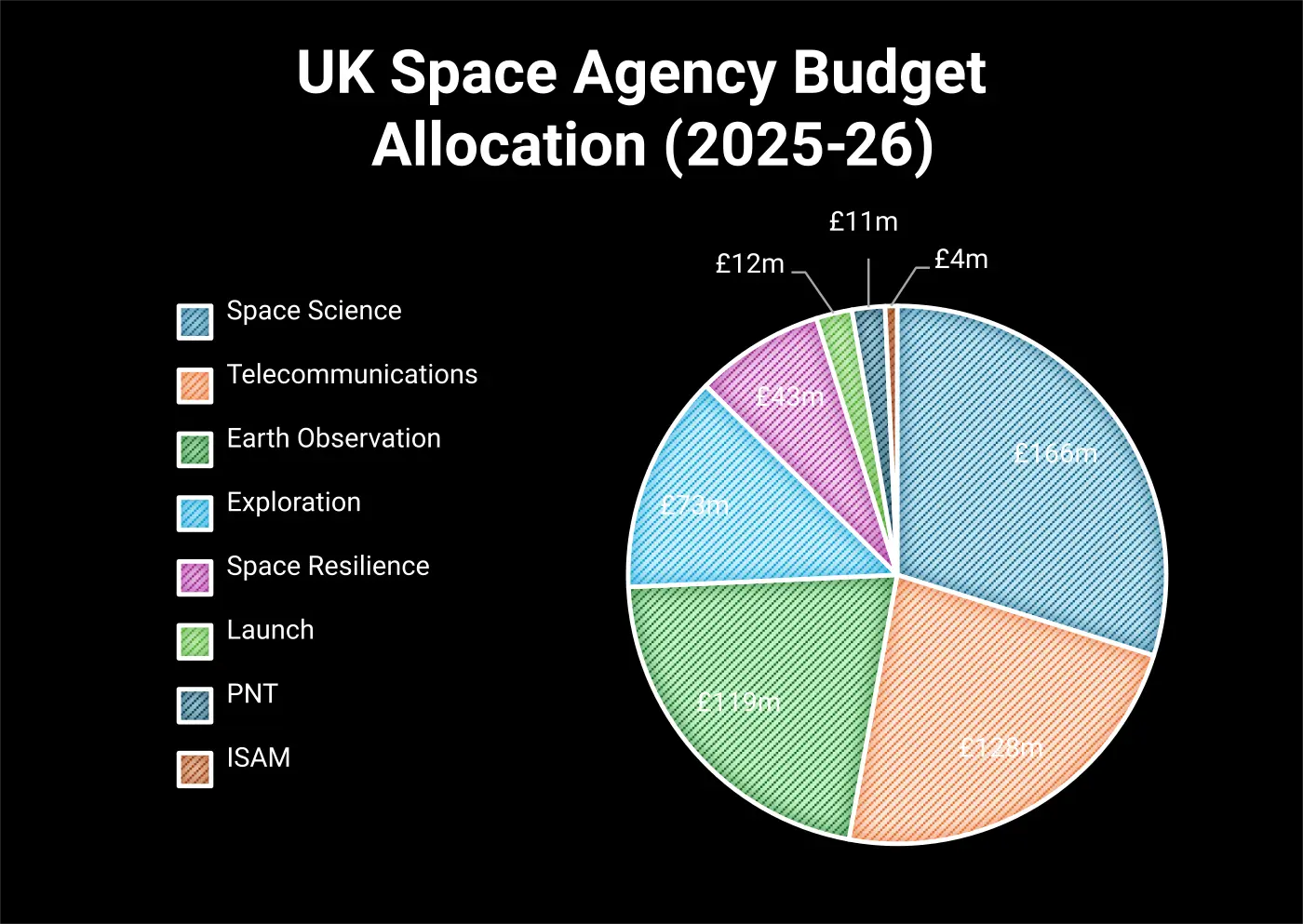
- Space Science: The cornerstone of the UK’s academic and industrial collaboration. This funding supports the UK's role in major international missions like the James Webb Space Telescope and the upcoming Ariel mission. Ideal for researchers, payload engineers, and those with a background in science and maths.
- Telecommunications: This is all about satellite communications capability, including high-speed satellite internet, mobile connectivity (5G/6G integration), and direct-to-device services. Look for roles in RF (Radio Frequency) engineering, software-defined networking, and cybersecurity. Trends in space telecommunication mean those with experience in terrestrial network and communications experience are in high demand. This sector employs many other disciplines such as business, finance, law, HR.
- Earth Observation: Monitoring our planet from above. This focus area is critical for the UK’s "Net Zero" targets and national security. This is the perhaps the most "transferable" sector. Data scientists, GIS specialists, software engineers, ecologists, biologists, geographers will find their skills are needed here.
- Exploration: Primarily focused on robotics and human-assisted exploration. The UK is a key partner in NASA’s Artemis lunar program and is developing the tech to put humans back on the Moon. This area has a large demand for roles in robotics, autonomous systems, AI, as well as mining engineers, structural engineers, lawyers, physiologists and psychologists.
- Space Resilience: Focused on making space a safe and reliable domain. This involves Space Domain Awareness (SDA) - tracking debris and satellites to protect the "Space Critical National Infrastructure" we rely on every day. Jobs in this sector often include radar technology, orbital mechanics, and require people to do risk modelling and to use software engineering skills.
- Launch: The UK aims to become a European leader in small satellite launch capability while prioritising environmental sustainability. High-demand roles include mechanical engineers, propulsion engineers, as well as a large number of manufacturing, test and launch site technicians at spaceports such as those in Scotland and Cornwall.
- Position, Navigation and Timing (PNT): PNT is the "invisible utility" that supports everything from banking to Uber. The UK is developing a "System of Systems" to ensure we aren't solely reliant on the US-owned GPS. Jobs here are suitable for mathematicians, physicists, electronic, systems, and software engineers.
- In-Orbit Servicing, Assembly and Manufacturing (ISAM): An emerging sector, this is focused on production of high-grade materials, active debris removal capabilities, and in-orbit robotic assembly of large structures for applications like space-based solar power (see SUN case study if you want to learn more about this area). As a growing sector, lots of disciplines are needed, including robotics, electronics, propulsion, manufacturing, business development.
UKSA, DSIT, and ESA
Finally, it is useful to understand the difference between the UK Space Agency (UKSA), Department for Science, Innovation, and Technology (DSIT), and the European Space Agency (ESA).
- UK Space Agency (UKSA): They are part of the UK Government and set the UK’s space policy and spending, and they also fund some space activities. They do not build hardware and software.
- DSIT (Department for Science, Innovation and Technology): This is the government department that has recently absorbed the UK Space Agency. They run specific civil service internship schemes and offer policy-focused roles that shape the future of the sector.
- European Space Agency (ESA): The European Space Agency is funded by its member states and the UK is a member. ESA manages and funds many upstream and downstream space projects. Their ESA Graduate Trainee (EGT) program is legendary and if you are a graduate of a member state, it is an excellent opportunity.
2. Transferring to the Space Sector later in Your Career
Are you in precision manufacturing? The space sector needs your skills. Are you a software developer in Fintech? Space companies desperately need Python and C++ experts to handle massive datasets. Are you in legal, HR, finance, or business development? Every growing space startup needs these skills to grow. The industry is actively looking for transferable skills. Don't count yourself out because your degree doesn't say "space." Instead, focus on any relevant skills you have, for example:
- Technical: Coding, data analysis, CAD design, electronics, materials science.
- Soft Skills: Complex problem-solving, teamwork, adaptability, communication (explaining complex subjects to non-technical stakeholders), and resilience.
3. Apprenticeships and Alternative Pathways
There are many exciting options for individuals who want to pursue apprenticeships and non-degree pathways. Some companies also offer degree apprenticeships, where you can get a degree alongside working. There are a surprising number of apprenticeships offered by space companies and organisations, e.g. Space Forge, Airbus and UK Research and Innovation. In the past they have covered the following specialities:
- Electromechanical
- Manufacturing
- Laboratory Technician
- Procurement Officer
- Finance
As you can see, direct-entry roles (positions you can apply for after finishing school without a degree or prior training) are also available for those wishing to pursue a non-technical career in the space sector, such as in marketing and finance.

4. Get Your Hands dirty with Internships
Gaining experience through summer internships or placements are great ways to improve your employability in the UK space sector. For example, the UK’s Satellite Applications Catapult collects a series of internship opportunities for students interested in the space sector to gain hands-on experience here. Look at your local space cluster for lists of local space companies (e.g. Space West’s early careers guide).
5. Where to Look for Jobs?
While some roles appear on generic sites like Indeed or LinkedIn, you will have better luck on specialist boards:
- SpaceCareers.uk: the bible of the sector. Set up alerts here first.
- European Space Agency (ESA) Careers: specifically for those Young Graduate roles or direct employment.
- Royal Aeronautical Society (RAeS): their job board often has space engineering roles that overlap with aviation.
- Gradcracker: if you are a STEM graduate, their space sector filter is excellent for larger engineering schemes.
- UK Government advice: Careers and skills in space - GOV.UK
- There are hundreds of jobs in small space companies on the “Harwell campus” which are clustered around the UK’s European Space Agency base in Oxfordshire. More about it here: Space Cluster - Harwell Campus.
6. Networking
The UK space village is small. A face-to-face meeting is worth 100 emails.
- Space-Comm Expo: the big commercial trade show. Go here to meet the companies selling the actual hardware and services.
- Farnborough Air Show: mainly aeronautical companies, but often there’s a small space room with companies in.
- UK Space Conference: the biennial gathering of the UK space sector which is great to make connections.
- Harwell Campus Events: occasionally, the Harwell campus (where RAL Space and the Catapult are) has open days. If you can get to Oxfordshire, being physically present in that cluster could help.
7. Maximise Your CV
This is the most crucial step. Because space companies receive hundreds of applications from people who "just love space," you need to prove you have the technical competency to do the job. General CVs do not work here. You must tailor your application to the specific language of the job description, try to hit the key words mentioned in the job description. But how do you know if your CV is hitting the right marks for a space specialist recruiter? The Space Skills Alliance (SSA) is an organization dedicated to understanding and bridging the skills gap in the UK space sector. They have developed two very useful resources for you:
- See many relevant training courses that you could complete online or in person in their comprehensive space training catalogue.
- Use their CV Analysis Tool: the Space Skills Alliance offers an incredible, free resource specifically for job seekers in the space sector. Rather than guessing what keywords a recruiter is looking for, this tool uses data from hundreds of real space job adverts to analyse your CV text. It identifies the skills you have highlighted and, crucially, points out the skills you haven't mentioned that are commonly required for the roles you are targeting.
Watch the CV Workshop that SUN recorded with the company Astroscale on our YouTube channel.
Final Thoughts
The UK space industry is dynamic, welcoming, and desperate for fresh perspectives. By identifying your transferable skills, networking inside the community, and using smart tools like those from the Space Skills Alliance to sharpen your application, you can find your place in this exciting sector. We wish you every success as you take the next step towards a career in the UK space sector.